Escuche este artículo en audio.
If you are searching for an elderly home in Puerto Rico from Florida, New York, Texas or elsewhere in the United States, photographs and websites can only tell you so much.
Before making travel arrangements, paying a deposit or moving a parent into a facility, there is one basic question you should answer:
Is this elderly home actually licensed to operate in Puerto Rico?
Fortunately, this is something families can verify through the Puerto Rico government.
Who Licenses Elderly Homes in Puerto Rico?
The Puerto Rico Department of the Family (Departamento de la Familia), through its Licensing Office, is responsible for licensing and supervising public and private establishments that provide care to older adults.
The Department describes its role as protecting the welfare of residents and determining whether establishments comply with applicable laws and regulations.
Puerto Rico’s current licensing regulation is Regulation No. 9720, Regulation for the Licensing and Supervision of Establishments for the Care of Older Adults, approved in January 2026.
Under the current regulation, a license is generally issued for a period of two years and must be displayed in a location visible to residents and the public.
So when visiting a home, it is perfectly reasonable to ask:
“May I see your Department of the Family license?”
A legitimate facility should not be surprised by the question.
The Easiest Way to Check From the United States
You do not have to be physically in Puerto Rico to begin verifying a facility.
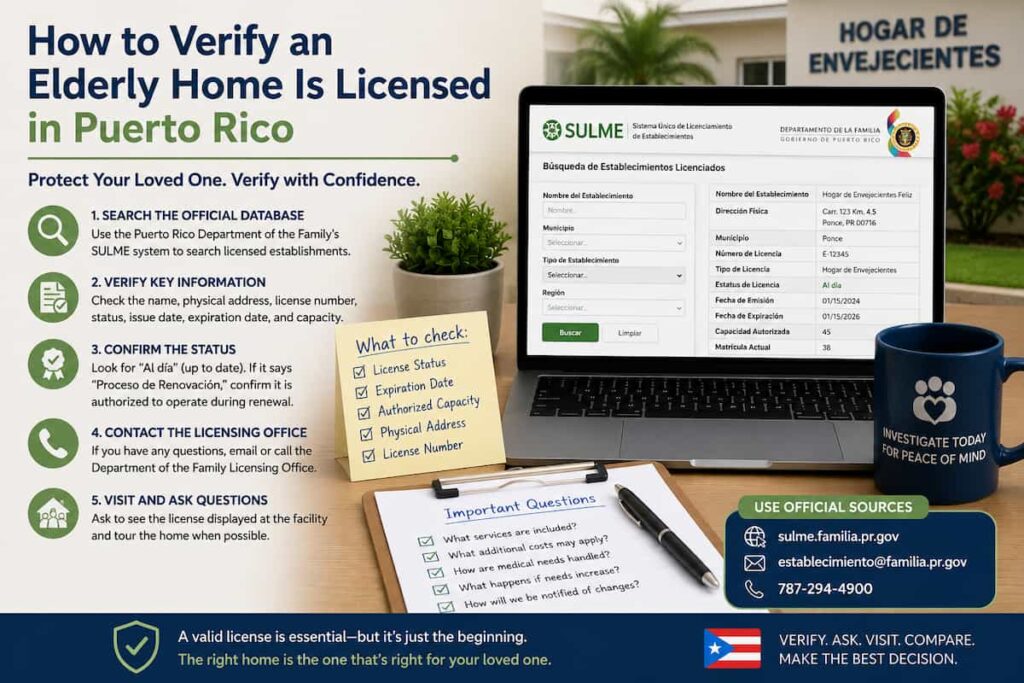
The Department of the Family maintains a public Licensed Establishments Search through its SULME system.
Search Puerto Rico’s licensed adult-care establishments
The system allows you to search by:
- Establishment name
- Municipality
- Region
- Type of establishment
The results can include the establishment’s physical address, telephone number, authorized capacity, license number, license issuance and expiration dates, and compliance information.
This is particularly valuable for families outside Puerto Rico because you can perform an initial government check before spending money on airfare or making arrangements with a facility.
Puerto Rico Also Publishes an Official List
The Department of the Family periodically publishes lists of licensed establishments.
As of this writing, the Department published an August 2026 List of Licensed Establishments for Older Adults.
View the Department of the Family document section
The August list is extensive and includes information such as:
- Name of the establishment
- Type of facility
- Municipality
- Establishment status
- Physical address
- Telephone number
- Type of license
- License number
- License expiration date
- License status
- Authorized capacity
- Current enrollment
For example, the government’s list distinguishes between the number of residents a facility is authorized to accommodate and the number currently enrolled.
That makes the government record useful for more than simply confirming that a name exists.
Do Not Search Only Once and Give Up
Puerto Rico business names can sometimes make searches confusing.
The name a family knows may not be exactly the name appearing in the government’s system.
For example, a facility may commonly use a shortened name while its license appears under:
- A corporation
- An individual’s name
- A legal business name
- A different spelling
- A name containing “Inc.,” “LLC” or another legal designation
If you cannot find the home immediately, try searching by the municipality instead and look through the establishments listed there.
Also ask the home for its license number.
That is a much stronger identifier than simply matching similar names.
Check the Address Too
Finding the correct name is only part of the verification.
Make sure the physical address on the government record corresponds to the facility you are considering.
Under Puerto Rico’s current licensing regulation, a license is tied to the specific location, operator, service and building for which it was issued. A license cannot simply be transferred from one location to another. Each separately operated establishment requires its own license number.
That means seeing the name of a company somewhere in the government database is not enough.
Verify that you are looking at the correct location.
This is particularly important when an operator has more than one home.
What Does “Al Día” Mean?
On the government list, families may see “Al día,” which essentially means the license is current or up to date.
You may also encounter another status:
“Proceso de Renovación” — Renewal in Process.
This deserves a little explanation.
The August 2026 government list contains establishments shown as being in the renewal process. Some records simultaneously show a license as current, while others show an expired date while the establishment is undergoing renewal.
Therefore, seeing “Proceso de Renovación” does not necessarily mean that the home is secretly operating without government oversight.
But it also means you should not make assumptions.
If the status is unclear, contact the Department of the Family Licensing Office and ask whether the facility is currently authorized to continue operating while its renewal is being processed.
That is much safer than trying to interpret the administrative status yourself.
What If You Cannot Find the Home at All?
This is where families should become cautious.
First, do not immediately accuse the facility of operating illegally. There may be an innocent explanation such as a different legal name, spelling variation or recently updated record.
Instead:
- Ask the facility for its full licensed name.
- Ask for its license number.
- Confirm its physical address.
- Search the government system again.
- If the information still does not match, contact the Department of the Family.
The Department’s public SULME system lists the Licensing Office contact email as [email protected].
The Department of the Family’s main telephone number is 787-294-4900.
A family thousands of miles away should not have to rely solely on what a facility tells them about its own licensing status.
Verify independently.
A License Is Important—but It Is Not a Recommendation
This distinction is extremely important.
Finding a home on the government’s licensed-establishment list tells you something valuable:
The establishment is part of Puerto Rico’s licensing and regulatory system.
It does not automatically tell you that it is the best home for your parent.
A license is not the same as a five-star review.
It cannot tell you whether:
- Staff members are warm and attentive.
- Your parent will be comfortable there.
- Residents appear clean and well cared for.
- Calls from family members are returned promptly.
- Meals are appealing.
- Staffing feels adequate at night.
- The facility communicates well during emergencies.
- Your parent will receive the particular level of assistance he or she requires.
Licensing should therefore be considered one important layer of verification—not the entire decision.
Verify the License, Then Ask About the Person
Once licensing has been confirmed, the conversation should shift from the facility to your parent.
Ask the home:
“Can you safely care for someone with my parent’s particular needs?”
Explain honestly whether your parent:
- Walks independently
- Uses a walker or wheelchair
- Needs help transferring
- Needs assistance bathing or dressing
- Is incontinent
- Has dementia or confusion
- Requires medication assistance
- Uses oxygen
- Has difficulty eating
- Is bedridden
- Requires frequent medical appointments
Do not minimize a parent’s needs simply because you are worried that the home may decline admission.
A home that is appropriate for an active 75-year-old may not be appropriate for a frail 92-year-old who needs help transferring from bed to a wheelchair.
The license is the beginning of your investigation, not the end.
If You Are in the States, Ask Someone to Visit for You
Whenever possible, have someone physically visit the home before placement.
That might be:
- A relative in Puerto Rico
- A trusted friend
- Another family member
- Someone involved in the parent’s care
A live video call can also help when an in-person visit is impossible.
Ask to see more than the lobby.
Look at the resident areas, bathrooms, bedrooms, dining area and outdoor spaces. Pay attention to how staff interact with residents.
One simple observation can sometimes tell you more than twenty photographs:
Do the residents appear to be treated like people living in a home—or like people being stored in a facility?
Ask About Emergency Preparedness
Puerto Rico’s realities make this particularly important.
Families should ask what happens during:
- Hurricanes
- Extended power outages
- Water interruptions
- Earthquakes
- Medical emergencies
- Evacuations
Puerto Rico law was strengthened in 2025 to require adult-care establishments to submit hurricane and emergency contingency plans to the Department of the Family, and additional legislation established requirements involving backup energy, potable-water storage and emergency supplies.
For a son or daughter living 1,500 miles away, these are not theoretical questions.
Ask:
How will you communicate with me if Puerto Rico loses power or telephone service after a hurricane?
That answer matters.
A Simple Verification Routine for Families Outside Puerto Rico
Before placing a parent in an elderly home in Puerto Rico, complete these steps:
1. Find the home on HogarDeAncianos.com or through another source.
Use directories to discover possible options and compare locations and services.
2. Verify the home independently with the Puerto Rico Department of the Family.
Search the government’s SULME licensing system.
3. Match the name, municipality and physical address.
Do not rely on the name alone.
4. Check the license number and status.
Pay attention to expiration and renewal information.
5. Ask the home to show you its current license.
Current regulations require the license to be displayed publicly.
6. Call the Department of the Family when something does not make sense.
Do not guess about an unusual status.
7. Then evaluate the quality and suitability of the home itself.
Licensing answers one question. Your parent’s comfort, safety and care require many more.
How HogarDeAncianos.com Fits Into the Process
HogarDeAncianos.com can help families discover elderly homes throughout Puerto Rico, narrow the search by location and learn more about available facilities.
But a directory and a government licensing system serve different purposes.
HogarDeAncianos.com helps you find possibilities.
The Puerto Rico Department of the Family is the source you should use to verify official licensing status.
We encourage families to use both.
When you are arranging care from outside Puerto Rico, independent verification is especially important because you may not be able to drive to a facility tomorrow and see it for yourself.
A few minutes checking the government record can give you something every family deserves before making such an important decision:
confirmation that the home you are considering is the home the Puerto Rico government knows about too.
Más artículos
Encuentra el hogar de ancianos ideal para tus seres queridos.