Escuche este artículo en audio.
What U.S. Families Should Arrange Before the Move
Moving an elderly parent to Puerto Rico is not simply a matter of buying an airline ticket and finding a place to live.
For an older adult—especially someone with several medications, mobility limitations or chronic medical conditions—the safest move is one in which health care, medications, documents and daily care are already waiting on the other side.
Families in Florida, New York, Texas and other states sometimes focus understandably on finding the elderly home first.
That is important.
But before your parent gets on the plane, there are several other pieces that should already be in place.
Think of This as a Transfer of Care, Not Just a Move
A healthy adult can arrive in Puerto Rico and gradually find a doctor, pharmacy and other services.
An 85- or 90-year-old with heart disease, diabetes, dementia, limited mobility or oxygen needs may not have that luxury.
Ideally, the move should answer these questions in advance:
- Where will my parent live?
- Who will become the primary doctor in Puerto Rico?
- Where will prescriptions be filled?
- What happens if medication runs out?
- Which hospital would normally be used?
- Who has authority to make decisions if my parent cannot?
- Who should the elderly home call in an emergency?
- Does the parent’s health insurance work in Puerto Rico?
- How will the parent physically make the trip safely?
If several of those answers are still “we’ll figure it out when we arrive,” the move probably needs more preparation.
First: Make Sure the Puerto Rico Home Can Handle Your Parent’s Actual Needs
Do not describe the parent as they were two years ago.
Describe them as they are today.
Tell the elderly home honestly if your parent:
- Uses a walker or wheelchair
- Needs assistance getting out of bed
- Needs help bathing or dressing
- Is incontinent
- Has dementia, confusion or wandering behavior
- Uses oxygen
- Requires a special diet
- Needs help taking medications
- Has difficulty swallowing
- Has frequent falls
- Is bedridden
- Requires regular medical treatment
Then ask:
“Can you care for someone with these needs now, and what happens if those needs increase?”
A successful move begins with choosing a home that can realistically care for the person arriving.
Review Medicare Before Changing the Address
If your parent has Medicare, determine whether they have:
Original Medicare, or
Medicare Advantage.
This distinction can be very important when moving to Puerto Rico.
A permanent move outside a Medicare Advantage or Medicare drug plan’s service area can create a Special Enrollment Period allowing the beneficiary to change plans. Medicare states that when someone moves outside a plan’s service area, the enrollment opportunity generally begins the month before the move if the plan is notified in advance and continues for two full months after the move.
Do this before relocation whenever possible.
Do not wait until your parent needs a doctor in Puerto Rico to discover that the old plan’s provider network does not operate there.
Medicare also instructs beneficiaries to update their official Medicare address through the Social Security Administration.
If your parent has:
- Medicare Advantage
- Medicare Part D
- Medicaid
- Employer or retiree insurance
- TRICARE
- Veterans benefits
- Long-term care insurance
contact the relevant program or insurer and specifically say:
“This will be a permanent move to Puerto Rico.”
Ask what must be changed and on what date.
Obtain Medical Records Before Leaving the State
Do not assume your parent’s new physician in Puerto Rico will automatically have access to everything.
Under HIPAA, patients generally have the right to inspect and obtain copies of medical and health information maintained by covered health-care providers and health plans. That can include medical records, laboratory reports, imaging, insurance information and other records used in making health-care decisions.
Before the move, request the important records.
For an older adult with complex health issues, try to bring:
- Current diagnoses
- Medication list
- Medication dosages and schedules
- Allergies
- Recent laboratory results
- Recent hospital discharge summaries
- Recent imaging reports
- Surgical history
- Vaccination information
- Specialist reports
- Current treatment plans
- Medical equipment orders
- Oxygen prescriptions, if applicable
You may not need a twenty-year medical history.
What the new care team needs most is a clear picture of what is happening now.
Ask the Current Doctor for a Simple Medical Summary
One of the most useful documents may not be a giant medical chart.
Ask the current physician whether they can provide a concise clinical summary explaining:
- Major diagnoses
- Important previous procedures
- Current medications
- Allergies
- Current functional limitations
- Recent major changes in health
- Important specialists
- Ongoing treatments
A physician in Puerto Rico who has never met your parent can understand a good two-page summary much faster than several hundred pages of disconnected records.
Keep the complete records too—but put the summary on top.
Do Not Pack the Medications in the Checked Suitcase
An elderly parent’s essential medications should travel with the parent or responsible caregiver whenever practical.
TSA permits medications through airport screening. Medically necessary liquids may exceed the normal 3.4-ounce liquid limit, although they must be declared for screening. TSA also recommends placing medications in carry-on baggage when immediate access may be necessary.
For the move, carry:
- Current medications
- An up-to-date medication list
- Enough medication to cover the transition period
- Prescription information
- Necessary inhalers
- Insulin and diabetic supplies, if applicable
- Emergency medications
- Required medical supplies
Do not make the final dose of an important medication coincide with arrival day.
Allow enough time to establish a Puerto Rico pharmacy and new prescribing physician.
Confirm That Prescriptions Can Be Continued
Before leaving, identify a pharmacy near the elderly home and check whether it participates in your parent’s prescription plan.
For medications that require frequent monitoring, controlled prescriptions, injections or special handling, speak with the current physician and insurer before relocation.
The question is not merely:
“Can I find this medicine in Puerto Rico?”
The better question is:
“Who will prescribe it, who will dispense it, and will the insurance cover it after the move?”
Those are three separate issues.
If Your Parent Uses Oxygen, Plan the Flight Early
This deserves special attention.
Passengers cannot simply bring their own compressed or liquid medical-oxygen cylinder onto a commercial aircraft.
FAA guidance states that passengers may not carry their own compressed or liquid oxygen in checked baggage, carry-on baggage or on their person. Airlines may provide oxygen under specific rules, although airlines are not required to offer that service.
Portable oxygen concentrators are treated differently and may be permitted when applicable requirements are met.
If your parent uses oxygen:
Contact the airline well before the travel date.
Tell them exactly what equipment the parent uses and ask what documentation, approved equipment and battery capacity will be required.
Also discuss the trip with the parent’s physician.
Do not arrive at the airport carrying an oxygen cylinder and expect the airline to solve the problem at the gate.
Consider the Entire Travel Day
An older adult who normally manages well at home may become exhausted during a travel day involving:
- A drive to the airport
- Security screening
- Walking through a large terminal
- Waiting at the gate
- A several-hour flight
- Baggage collection
- Transportation from the Puerto Rico airport
- Arrival at an unfamiliar residence
Arrange wheelchair assistance with the airline if appropriate—even if your parent normally walks short distances.
Saving their energy for the actual move can be much more important than proving they can walk through an airport.
Also consider:
- Bathroom assistance
- Meals
- Hydration
- Medication timing
- Incontinence supplies
- Hearing aids
- Glasses
- Chargers
- Mobility equipment
- A change of clothing
For a frail older adult, the travel day itself should be considered part of the care plan.
U.S. Citizens Do Not Need a Passport Just to Travel From a State to Puerto Rico
Puerto Rico is a U.S. territory.
USAGov confirms that U.S. citizens do not need a passport to travel between the United States and Puerto Rico.
However, adults still need acceptable identification for TSA screening.
Since May 7, 2025, a state driver’s license or identification card that is not REAL ID compliant is generally no longer accepted at airport security unless the traveler presents another acceptable form of identification, such as a U.S. passport.
Check the parent’s identification before travel day, particularly if they stopped driving years ago and have not updated their ID recently.
Decide Who Has Authority Before There Is an Emergency
This is one of the easiest things to postpone and one of the hardest things to fix after a parent loses the ability to make decisions.
While your parent can still make their own decisions, discuss:
- Who should speak for them medically if they become unable?
- Who can obtain medical information?
- Who can handle financial matters?
- Who can communicate with insurers?
- Who can sign necessary documents?
- What treatments would the parent want or refuse in a serious medical situation?
Puerto Rico recognizes advance health-care planning under its laws, including the Ley de Declaración Previa de Voluntad sobre Tratamiento Médico, which allows individuals to express certain medical-treatment wishes in advance.
Federal HIPAA rules also recognize properly authorized personal representatives; HHS notes, for example, that someone with appropriate health-care power of attorney may have access to medical records within the scope of that representation.
But legal documents can differ in wording and scope.
If your parent’s power of attorney, health-care proxy, advance directive or similar document was prepared in another state, have an attorney familiar with Puerto Rico law review whether it will accomplish what the family expects after the move.
Do this while the parent can still participate.
Give the Elderly Home the Right Documents
The home should receive copies of relevant information, but the family should keep the originals or master copies.
Provide, as appropriate:
- Identification
- Medicare and insurance cards
- Medication list
- Allergies
- Physician information
- Emergency contacts
- Advance directives
- Appropriate health-care authorization
- Relevant power-of-attorney information
- Dietary information
- Hospital preference
- Funeral or religious preferences, if the family has chosen to document them
Ask the home which documents it specifically requires for admission.
Create Two Identical Emergency Folders
This is a simple system that can make long-distance caregiving much easier.
Folder 1 stays with the parent in Puerto Rico.
Folder 2 stays with the primary family contact in the States.
Both should contain copies of the essential information.
Add:
- Full legal name and date of birth
- Current address
- Elderly-home contact information
- Insurance information
- Medication list
- Diagnoses
- Physicians
- Emergency contacts
- Legal representative information
- Advance directive
- Recent medical summary
A secure digital copy can provide another backup.
If something happens at 2:00 a.m., you do not want the only copy of an important document sitting in a filing cabinet 1,500 miles away.
Establish a Puerto Rico Medical Contact Before the Move When Possible
If the elderly home normally works with a physician, ask how that arrangement works.
Questions should include:
- Does a physician visit the home?
- Is that physician your parent’s primary doctor?
- Can the family choose another physician?
- Who renews prescriptions?
- Who is called when the parent’s condition changes?
- Who decides whether the parent needs the emergency room?
- Which hospital is normally used?
If your parent needs specialists—cardiology, pulmonology, neurology, oncology or another specialty—begin identifying those providers before arrival.
A safe transition should minimize the period during which nobody clearly owns responsibility for ongoing medical care.
Do Not Forget the Person Behind the Paperwork
For the family, the move may feel like a project:
insurance, records, flights, doctors, payments, signatures.
For the parent, it may mean leaving:
- Their house
- Their physician
- Friends
- A familiar neighborhood
- Their routines
- Their possessions
- Perhaps the state where they lived for decades
Whenever possible, involve them in decisions.
Bring familiar photographs, a favorite blanket, a chair, religious items, music or other small pieces of home.
If Puerto Rico is where they grew up, returning may feel comforting.
If Puerto Rico is unfamiliar, the transition may feel very different.
The logistics matter, but so does the landing.
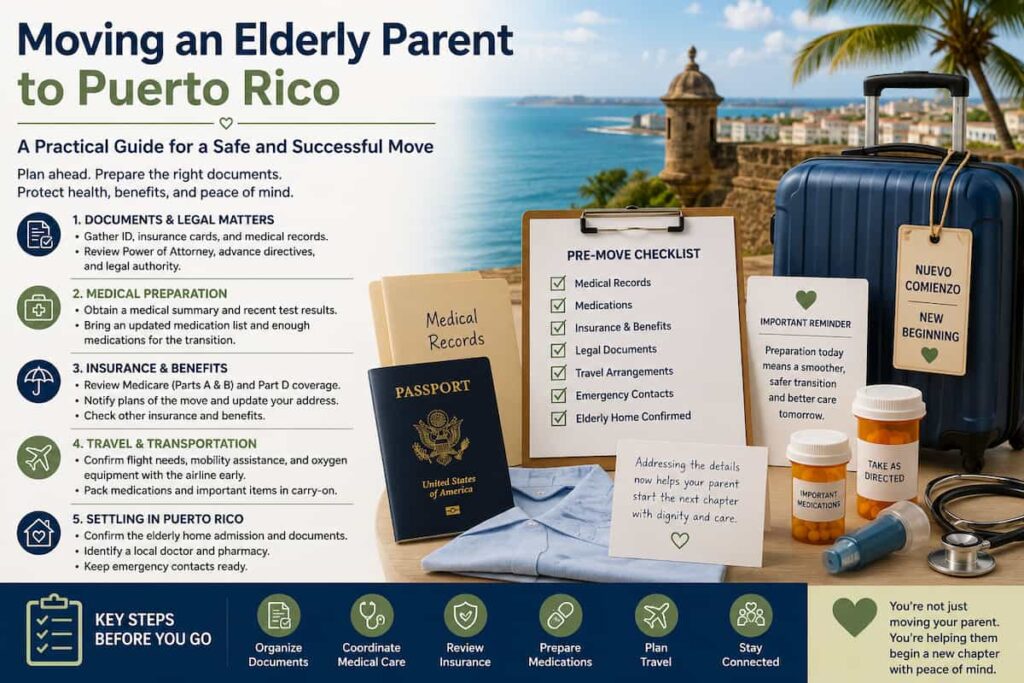
A Practical Before-the-Flight Checklist
Before your parent leaves the States, try to have all of these marked complete:
Housing
- Elderly home selected
- Puerto Rico license independently verified
- Admission date confirmed
- Total monthly cost understood
- Required admission documents completed
Medical
- Puerto Rico physician identified
- Medical records obtained
- Medical summary obtained
- Medication list updated
- Adequate medication supply arranged
- Pharmacy identified
- Oxygen or other medical equipment coordinated
Insurance
- Medicare coverage reviewed
- Medicare Advantage or Part D move reported, if applicable
- New plan selected if necessary
- Official address-change process understood
- Medicaid or other benefits reviewed separately
Legal
- Health-care decision authority reviewed
- Financial authority reviewed
- Advance directive available
- Puerto Rico legal review obtained when necessary
- Copies provided to appropriate people
Travel
- Airline notified of mobility or medical needs
- Wheelchair assistance arranged if appropriate
- Oxygen arrangements confirmed
- Medications packed in carry-on
- Acceptable identification confirmed
- Transportation from the Puerto Rico airport arranged
Family
- Primary Puerto Rico contact identified
- Primary mainland contact identified
- Emergency communication plan established
- Copies of essential documents stored in both locations
The Goal Is Not a Perfect Move
Very few elder-care transitions happen without some adjustment.
A medication may need to be changed. A new physician may want different tests. A parent may take time to adapt to the home.
The goal is not to eliminate every possible surprise.
The goal is to eliminate the avoidable ones.
A family should not discover after landing in Puerto Rico that the parent’s Medicare Advantage plan has no local network, that nobody can refill an important medication, that the oxygen equipment cannot travel on the airplane, or that nobody has clear legal authority when an emergency occurs.
Those are problems that can often be addressed before the move.
HogarDeAncianos.com can help families begin one of the most important parts of this process: identifying and comparing elderly homes throughout Puerto Rico.
Once you find the right possibilities, think beyond the address.
The successful move is not the day your parent arrives in Puerto Rico.
It is the point at which their care continues without falling through the cracks.
Más artículos
Encuentra el hogar de ancianos ideal para tus seres queridos.