Escuche este artículo en audio.
How to Manage Their Care From a Distance
Your mother is in an elderly home in Puerto Rico.
You are in Florida.
Or New York. Texas. Pennsylvania. Connecticut.
Your phone rings with a Puerto Rico area code and, before answering, you immediately wonder:
What happened?
Long-distance caregiving creates a particular kind of anxiety. You cannot stop by the home after work. You cannot easily attend every doctor’s appointment. If your parent’s condition changes, you may be more than a thousand miles and an airplane flight away.
But distance does not mean you have to be disconnected from your parent’s care.
The key is to build a system before there is an emergency.
Do Not Make “Call Me If Something Happens” the Entire Plan
Almost every family says this.
“Please call me if anything happens.”
The problem is that different people have very different definitions of something.
Does that include a minor fall?
A medication change?
Refusing meals for two days?
New confusion?
A fever?
A trip to the emergency room?
A doctor recommending hospice?
A power outage?
The solution is to be much more specific.
Ask the elderly home which changes automatically trigger a family call and make your expectations clear.
You might want immediate notification after a fall, emergency-room transfer, hospitalization, significant breathing difficulty, sudden confusion, injury, major medication change or other substantial change in condition.
Then establish what can wait for your regular update.
The goal is not to have the home call you every time your parent refuses dessert.
It is to make sure everyone agrees about what cannot wait until tomorrow.
Establish One Primary Family Contact
When several adult children are involved, communication can quickly become chaotic.
One sibling calls the home in the morning.
Another calls that afternoon.
A third receives information from a cousin.
Soon three slightly different versions of the same story are circulating through the family.
Whenever possible, designate one primary family contact and one backup.
The home should know:
Primary contact: who should normally be called first.
Backup contact: who should be called if the first person cannot be reached.
The primary contact can then update the rest of the family.
This also makes life easier for the home’s staff, who should be spending their time caring for residents rather than repeating the same update to five relatives.
Create a Regular Communication Rhythm
Do not wait for emergencies to communicate.
Agree on a reasonable schedule with the home.
For some families, a short weekly conversation is enough. For a parent whose condition is changing rapidly, communication may need to occur more frequently.
A useful regular update can cover five simple areas:
Eating: Is Mom eating and drinking normally?
Mobility: Is she walking or transferring about the same as before?
Mental status: Is she alert and behaving normally for her?
Medical: Any new symptoms, appointments, medication changes or physician instructions?
General: Any falls, skin problems, behavioral changes, sleep problems or other concerns?
Those five questions can tell you much more than asking:
“How is Mom doing?”
The answer to that question will almost always be:
“She’s doing okay.”
Learn the Names of the People Actually Caring for Your Parent
Know more than the name of the facility.
Ask who manages the home and who normally handles your parent’s care.
Know the administrator or director.
Know who handles medications.
Know which physician normally sees your parent.
Know which pharmacy is used.
Know which hospital the home normally uses when someone needs emergency evaluation.
Keep those names and telephone numbers together.
When something changes suddenly, you should not have to search through six months of text messages to remember the doctor’s name.
Do Not Assume Being the Son or Daughter Automatically Gives You Complete Medical Access
This surprises many families.
HIPAA does not automatically give every adult child unrestricted access to a parent’s medical records simply because they are family.
When an adult patient has decision-making capacity, health-care providers may share relevant information with family members involved in the person’s care when the patient agrees, does not object, or the provider reasonably determines the patient does not object. But that is not necessarily the same as giving the adult child full authority to obtain records or make medical decisions.
A legally recognized personal representative generally has broader rights under HIPAA within the scope of that person’s authority. HHS explains that whether someone is a personal representative depends on the authority granted under applicable law—for example, authority to make health-care decisions.
If your parent is still able to make decisions, this is the best time to establish who should receive medical information and who should act if your parent later becomes unable to speak for themselves.
Do not wait until your parent is unconscious in an emergency room to discover that nobody is certain who has authority.
Keep Your Own Current Medical Summary
Maintain a simple record of your parent’s current situation.
This does not need to become a complicated medical database.
At minimum, you should have one current document containing:
- Full name and date of birth
- Medicare and insurance information
- Major diagnoses
- Current medications and dosages
- Allergies
- Elderly-home information
- Primary physician
- Important specialists
- Preferred hospital, if applicable
- Emergency contacts
- Health-care representative or other relevant legal authority
- Advance directive information
Update it whenever something significant changes.
HHS confirms that individuals—and generally their authorized personal representatives—have rights to access medical information maintained by covered health-care providers and plans.
Having your own current summary becomes especially valuable when you are coordinating care across several doctors or explaining the situation to someone who has never met your parent.
Ask to Be Told When Medications Change
Medication lists in older adults can become complicated surprisingly quickly.
A hospital adds one medication.
A specialist stops another.
The home has an older list.
The family has a photograph of a medication list from six months ago.
Nobody is intentionally doing anything wrong—but now several versions exist.
Ask the home or responsible health-care provider how medication changes are documented and how the family is informed.
When you receive a significant change, record:
What was added or stopped? Why? Who ordered it? When did it start?
You do not need to second-guess every medical decision.
You simply need to know what your parent is currently receiving.
Have Someone Local You Trust
Even with a good elderly home, a local family member or trusted friend can be extremely valuable.
Ideally, identify someone in Puerto Rico who could physically reach your parent if necessary.
This person might occasionally visit, deliver something, accompany the parent to an important appointment or simply provide independent eyes and ears.
They do not have to manage the care.
They are your local backup.
If a hurricane affects communications and you cannot reach the home, knowing that someone thirty minutes away can check on the situation provides an entirely different level of reassurance than having every responsible family member living on the mainland.
Use Video Calls for More Than Conversation
Video calls are valuable because they let you see things that a telephone conversation cannot show.
Watch how your parent looks.
Are they noticeably thinner?
Are they alert?
Is their appearance consistent with what you expect?
Can they move as they normally do?
Do they seem comfortable?
You can also ask the home to include you by video during an important conversation when practical.
Distance does not have to mean every important care discussion occurs without you.
Puerto Rico Requires an Emergency Plan of Its Own
Long-distance families should think seriously about hurricanes, earthquakes and extended utility interruptions.
Do not wait until a hurricane is approaching Puerto Rico to ask what the elderly home does when the electricity goes out.
Ask ahead of time about backup electricity, water, medications, food, medical equipment, communication and evacuation.
Federal emergency-preparedness guidance for older adults specifically recommends planning for medications and medical supplies, keeping copies of insurance information and important documents, considering transportation needs, and preparing for assistive equipment and power requirements.
For a family outside Puerto Rico, add one more question:
How will the home communicate with us if normal cellular or internet service is unavailable?
Write down the answer before hurricane season.
Decide What Happens if Your Parent Goes to the Hospital
This deserves its own plan.
Ask the home:
Which hospital do you normally use?
Who decides that a resident needs to go?
Does someone accompany the resident?
Who sends the medication list and medical information?
Who calls the family?
Who speaks with the hospital if the parent cannot communicate?
What happens when the parent is discharged?
A 2:00 a.m. emergency is not the time to invent this process.
For an immediate emergency in Puerto Rico, the emergency system is 9-1-1. The Puerto Rico government’s Emergency Systems Bureau operates the island’s 9-1-1 system.
Keep Track of Changes Over Time
One isolated event may mean very little.
A pattern may mean a great deal.
Keep brief notes when something important happens.
For example:
“March 4 — fall, no injury.”
“March 18 — eating less.”
“April 2 — medication changed.”
“April 12 — second fall.”
“April 20 — physician says mobility declining.”
Individually these may seem unrelated.
Together they may show that your parent’s level of care is changing.
Long-distance family members often speak with different people at different times. A simple timeline prevents important changes from disappearing into old telephone conversations and text messages.
Know When to Ask More Questions
Trust between the family and the elderly home is important.
But trust does not mean never asking questions.
Pay attention when explanations repeatedly do not make sense, communication suddenly becomes difficult, your parent’s condition appears substantially different from what you are being told, unexplained injuries occur, medications cannot be accounted for, or you consistently cannot obtain basic information about care.
One confusing conversation is not evidence of mistreatment.
A persistent pattern deserves attention.
Start by calmly asking the administrator for clarification.
If necessary, request a formal discussion about the concern and document what was discussed.
Know That Families Have Somewhere Else to Turn
Families outside Puerto Rico sometimes feel powerless because they are not physically on the island.
You are not limited to resolving every serious concern directly with the elderly home.
Puerto Rico has an Office of the Advocate for Older Persons — Oficina del Procurador de las Personas de Edad Avanzada (OPPEA).
OPPEA states that it is responsible for protecting the rights of older adults and also carries the functions associated with advocacy for residents of long-term-care establishments. Its Protection and Advocacy unit receives, channels and investigates complaints involving mistreatment and violations of older adults’ rights.
Its main San Juan number is 787-721-6121.
The Puerto Rico government also lists a maltrato (abuse) reporting line at 787-749-1333.
For an immediate threat to life or safety, call 9-1-1.
These resources should not replace ordinary communication with a facility. They are there for situations in which there is a genuine concern about safety, abuse, neglect or rights.
Continue Checking the Home’s Official Status
Even after your parent has moved into a home, it is reasonable to periodically verify that the establishment continues to appear in the Puerto Rico Department of the Family’s licensed-establishment system.
The Department currently provides a public search tool allowing families to verify licensing status by establishment, municipality and other criteria.
A family’s responsibility does not end the day the admission contract is signed.
Visit When You Can—but Use the Visit Wisely
When you travel to Puerto Rico, spend time with your parent.
Not every visit needs to become an inspection.
Have lunch together.
Talk.
Sit outside.
Look at photographs.
Let your parent enjoy having their son, daughter or grandchildren there.
But during the visit, naturally observe the environment too.
Speak with the people caring for them.
Confirm the medication list.
Ask whether anything has changed.
Look at the room.
Find out when the next doctor appointment is.
The best monitoring often happens simply because you are present and paying attention.
Distance Does Not Mean You Are Abandoning the Care to Someone Else
There is an important distinction between providing care and managing care.
The elderly home may provide the daily hands-on assistance.
The doctor provides medical care.
The pharmacy supplies medication.
But the family can still remain the person who sees the entire picture.
You may be the one who notices that three falls occurred within six weeks.
You may remember that a medication was added immediately before a new problem began.
You may know that your mother would never want a particular treatment.
You may recognize from her voice that something is wrong even when everyone else says she seems fine.
That knowledge still matters from a thousand miles away.
A Simple Long-Distance Care System
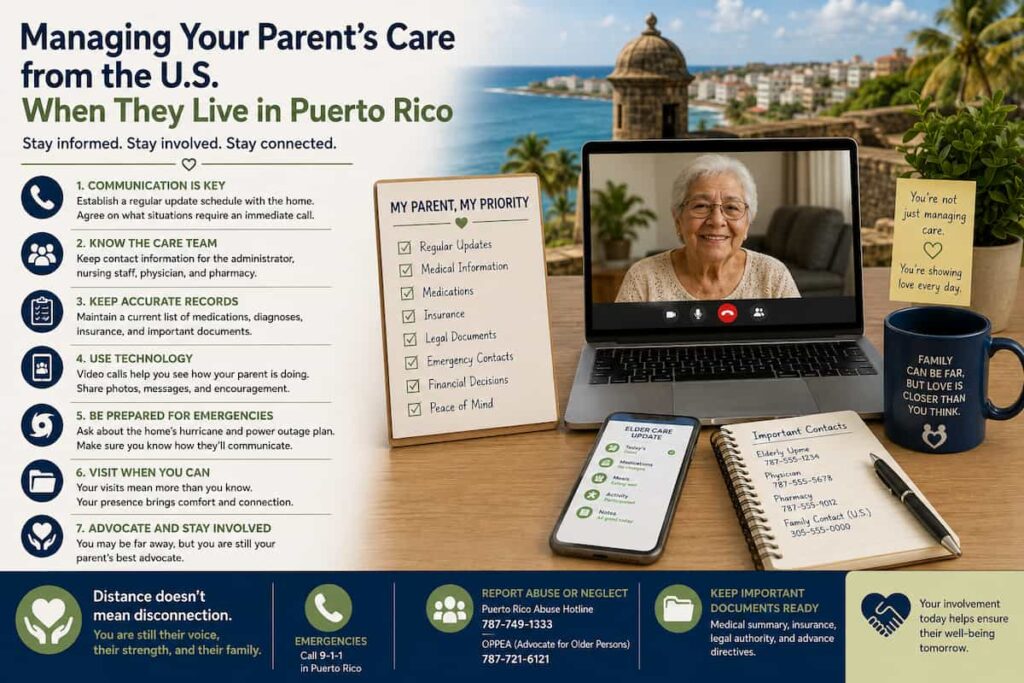
Keep one current medical summary. Designate one primary family contact and one backup. Establish a regular update schedule with the home. Know the doctor, pharmacy and usual hospital. Make sure appropriate medical-information and decision-making authority is established. Maintain a trusted local contact in Puerto Rico. Agree on what events require an immediate call. Have a hurricane and emergency communication plan. Keep a dated record of significant changes. And know where to turn if you develop a serious concern.
You do not need to call the elderly home three times every day to remain involved.
You need reliable information, clear responsibilities and a plan for when something changes.
HogarDeAncianos.com can help families locate elderly homes throughout Puerto Rico and find information about care on the island. But once your parent is living in a home, perhaps the most important role you can continue to play is something no directory, government agency or facility can replace:
being the person who knows your parent, pays attention, asks questions and remains involved—even from far away.
Más artículos
Encuentra el hogar de ancianos ideal para tus seres queridos.